

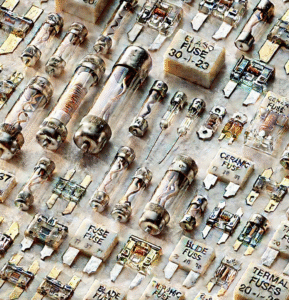
Every time you flip a switch, plug in your phone, or brew a morning cup of coffee, you’re relying on one silent hero of modern life: the fuse. Fuses are tiny devices designed to protect our homes, businesses, and lives from the dangers of electrical overloads and fires. But while they may look small and unassuming, their history is anything but simple. The journey of the fuse traces back more than a century and reflects the rapid growth of electricity, the struggle for safety, and the evolution of technology that powers our daily lives. ⚡
In this article, we’ll take a detailed look at how fuses were born, how they changed over time, and why they remain a cornerstone of electrical safety today.
The Origins of Fuses
The earliest concept of a fuse dates back to the late 19th century, at the dawn of widespread electrical use. As cities began wiring homes and businesses for electricity, fires and accidents became common. Engineers needed a way to automatically cut power when electrical circuits were overloaded.
The first practical fuse is credited to Thomas Edison in 1890. Edison designed it as a simple wire that would melt when too much current flowed through it, stopping the electrical supply before it could cause serious damage. His design was patented as part of his broader innovations in electrical distribution. At the time, these fuses were housed in screw-in cartridges that could be replaced once burned out.
The U.S. Patent and Trademark Office still recognizes Edison’s fuse patent as a foundational element in electrical safety.
Early Adoption in Homes and Industry
By the early 20th century, fuses were becoming a standard fixture in electrical systems. They were inexpensive, simple to use, and highly effective. For homeowners, this was revolutionary—fuses prevented house fires caused by overloaded wiring, a common issue as people added more appliances to their homes.
In industry, fuses were crucial for protecting expensive machinery and preventing power outages. Their introduction marked the beginning of safer electrical grids, allowing electricity to expand rapidly into every corner of society.
Evolution of Fuse Technology
Though Edison’s original idea was ingenious, early fuses had limitations. They often needed to be manually replaced, which was inconvenient and sometimes dangerous. Over time, manufacturers developed more advanced designs to improve safety and usability.
Cartridge Fuses
By the mid-1900s, cartridge-style fuses became common. These were enclosed in protective casings that reduced the risk of fire and made replacement safer. They came in various sizes and ratings, ensuring compatibility with different electrical systems.
Automotive Fuses
As cars became mainstream, engineers realized vehicles needed reliable electrical protection, too. The first automotive fuses appeared in the 1920s and evolved into the blade-type fuses widely used in cars today.
High-Voltage Fuses
For industrial and utility applications, high-voltage fuses were introduced to safeguard massive electrical equipment like transformers and substations. These heavy-duty fuses are designed to handle thousands of volts and protect critical infrastructure.
IEEE provides extensive research and historical records on the engineering breakthroughs that enabled these innovations.
Fuses vs. Circuit Breakers
As electrical systems advanced, another device entered the picture: the circuit breaker. While fuses melt to stop the flow of electricity, circuit breakers mechanically “trip” and can be reset instead of replaced. By the mid-20th century, circuit breakers started gaining popularity in homes and businesses.
Still, fuses remain widely used today. They are cheaper, faster at interrupting dangerous surges, and often more reliable in specific applications, such as automotive and high-voltage systems. The relationship between fuses and circuit breakers reflects the diversity of electrical safety solutions—each has unique advantages depending on the setting.
For a deeper look at how circuit protection works, check resources from the National Fire Protection Association (NFPA), which sets standards for electrical safety worldwide.
The Role of Fuses in Modern Life
Despite the rise of circuit breakers, fuses are far from obsolete. They continue to play a vital role in everyday life:
-
Consumer Electronics: Tiny fuses are embedded in gadgets, chargers, and appliances.
-
Automobiles: Blade fuses protect wiring and ensure vehicles operate safely.
-
Industrial Systems: High-voltage fuses secure electrical grids and heavy machinery.
-
Renewable Energy: Solar panels and wind turbines rely on fuses for surge protection.
In fact, as technology becomes more advanced, the demand for specialized fuses grows. Modern fuses are designed with precision, tailored for everything from spacecraft to smartphones. 🌍🚗📱
The Cultural Impact of Fuses
Beyond technology, fuses have left their mark on culture and language. The phrase “blowing a fuse” has become synonymous with losing one’s temper, a nod to the sudden and dramatic way a fuse operates. Similarly, fuses appear in countless movies, books, and metaphors, symbolizing both fragility and explosive release.
This cultural footprint highlights how deeply fuses are woven into human experience—both practically and symbolically.
The Future of Fuses
Looking ahead, the fuse continues to evolve. Innovations in smart fuses are emerging, allowing real-time monitoring of circuits and predictive failure alerts. These developments could reduce downtime in industries and improve safety in homes.
As renewable energy systems expand, fuses will play an even bigger role in protecting clean energy grids. The demand for lightweight, efficient, and eco-friendly fuses is shaping the next generation of safety devices.
ScienceDirect publishes ongoing research on fuse technology and its applications in modern electrical engineering.
Conclusion
From Edison’s first patent to the modern smart grid, the fuse has stood the test of time as one of the most important safety devices in human history. Simple, effective, and reliable, fuses have protected countless homes, businesses, and lives for over a century.
While circuit breakers and digital technology have joined the safety landscape, the fuse remains indispensable. Next time you flip a switch or start your car, remember the humble fuse quietly standing guard, ensuring electricity remains a servant—not a danger. ⚡
The history of fuses isn’t just about wires and circuits—it’s about progress, innovation, and the human drive to make our world safer.
✅ Authority Sources Used: